Apple - iPad mini - TV Ads - Books - YouTube:
'via Blog this'
Is Moby-Dick a favorite for commercials? http://www.youtube.com/watch?v=9L11hutds-o
Of ALL the books in the world, and all the books especially in the public domain that one can read off the new iPad Mini, Moby-Dick once again surfaces to the top of the list.
Granted, in this commercial, Moby-Dick is actually on the big iPad, trying to show the difference. Also on the big iPad is East of Eden, another very long novel. I can't say for sure if that is what they are showing--big, unwieldy novels versus short novellas. I don't know how long Louis L'Amour's How the West Was Won is, or Jack London's The Valley of the Moon. In fact, that Jack London book is a strange choice, if that is the case. I actually have never even heard of The Valley of the Moon (and I am an English major), and a better choice would have been the very short Call of the Wild by London.
However, Moby-Dick gets into yet another new technology commercial. Of all the books in the world. Personally, I still think I never would have finished Moby-Dick had it not been for my Sony eReader. I wonder how many new readers of Moby-Dick are trying it out on these new technologies?
No, I really want to know. It would tell me a lot as someone very critical of the novel. People have these amazing new technologies for reading easily. And Moby-Dick is free in a hundred different ways. So if people are using these technologies, are they reading a free book that is considered a classic the world over? If it is so darn good, why aren't people reading it?
Sunday, November 25, 2012

Saturday, November 10, 2012
The Whale: Bulk Delivery - Page 1 - Theater - New York - Village Voice
The Whale: Bulk Delivery - Page 1 - Theater - New York - Village Voice:
'via Blog this'
Proving yet again that if all you do is say "whale" that "Moby Dick" will soon follow...
Some play about a fat man...and you know how we always call fat people whales...
"Charlie has been slowly eating himself to death for a dozen years, like a self-swallowing Jonah, or an Ahab who is the target of his own vengeance. "
Apparently to add the subliminal whale symbolism, or maybe the Ahab obsession complex (I really don't know myself, I'm guessing--haven't seen it), the main character also has an obsession: "An eighth grader's essay on Melville's Moby-Dick, or the Whale is one of Charlie's pet preoccupations. And another theme that has shaped his life turns out to be the Biblical story of Jonah and the whale, on which Melville's hero, Ishmael, hears a sermon early in the novel."
It must go even deeper because look at this analogy: "Into this vortex of unspoken tensions, a young Mormon missionary, who calls himself Elder Thomas (Cory Michael Smith), wanders, as unsuspectingly as Ishmael wandered into Father Mapple's chapel."
Fat guy is his own Moby Dick. Kind of interesting--and again, probably loads more interesting than Melville's novel itself, specifically for story structure.
'via Blog this'
Proving yet again that if all you do is say "whale" that "Moby Dick" will soon follow...
Some play about a fat man...and you know how we always call fat people whales...
"Charlie has been slowly eating himself to death for a dozen years, like a self-swallowing Jonah, or an Ahab who is the target of his own vengeance. "
Apparently to add the subliminal whale symbolism, or maybe the Ahab obsession complex (I really don't know myself, I'm guessing--haven't seen it), the main character also has an obsession: "An eighth grader's essay on Melville's Moby-Dick, or the Whale is one of Charlie's pet preoccupations. And another theme that has shaped his life turns out to be the Biblical story of Jonah and the whale, on which Melville's hero, Ishmael, hears a sermon early in the novel."
It must go even deeper because look at this analogy: "Into this vortex of unspoken tensions, a young Mormon missionary, who calls himself Elder Thomas (Cory Michael Smith), wanders, as unsuspectingly as Ishmael wandered into Father Mapple's chapel."
Fat guy is his own Moby Dick. Kind of interesting--and again, probably loads more interesting than Melville's novel itself, specifically for story structure.
Friday, October 19, 2012
AT&T Commercial featuring Moby Dick and Ryan Hall
AT&T Commercial (2012) (Television Commercial) @Popisms.com - Connecting Pop Culture:
'via Blog this'
AT&T commercial this year features Olympic runner Ryan Hall on a training run. He is showcasing the speed and ubiquity of the 4G network as he streams two books.
One is the epic poem by Homer The Odyssey. It is long. That is what they are focusing on.
He stops running because he needs another "read." So he chooses a long one--notoriously long, right? He chooses Moby-Dick.
The focus being on the interminable length of the novel seems to point to Moby-Dick being inaccessible unless a lot of time is devoted to it. However, it also shows that it must be an accessible read to be able to digest it while on the run.
Again, of all the books, they choose Moby-Dick. Not Ulysses, not even War and Peace, which is also notoriously long.
Just interesting.
'via Blog this'
AT&T commercial this year features Olympic runner Ryan Hall on a training run. He is showcasing the speed and ubiquity of the 4G network as he streams two books.
One is the epic poem by Homer The Odyssey. It is long. That is what they are focusing on.
He stops running because he needs another "read." So he chooses a long one--notoriously long, right? He chooses Moby-Dick.
The focus being on the interminable length of the novel seems to point to Moby-Dick being inaccessible unless a lot of time is devoted to it. However, it also shows that it must be an accessible read to be able to digest it while on the run.
Again, of all the books, they choose Moby-Dick. Not Ulysses, not even War and Peace, which is also notoriously long.
Just interesting.
Thursday, October 18, 2012
Herman Melville Books: Moby Dick Google Doodle - YouTube
Herman Melville Books: Moby Dick Google Doodle - YouTube:
'via Blog this'
Full Google Doodle animation at YouTube.
Google Doodle Moby-Dick
Herman Melville Gets The Google Doodle Treatment | WebProNews:
'via Blog this'
Today is the 161st anniversary of the publication of Moby-Dick October 18. And of all the stuff that Google creates its famous little Doodles for on its main page, Moby-Dick wins one.


Thursday, September 27, 2012
Rare albino whale puts on a show off Australian coast - CNN.com
Rare albino whale puts on a show off Australian coast - CNN.com:
'via Blog this'
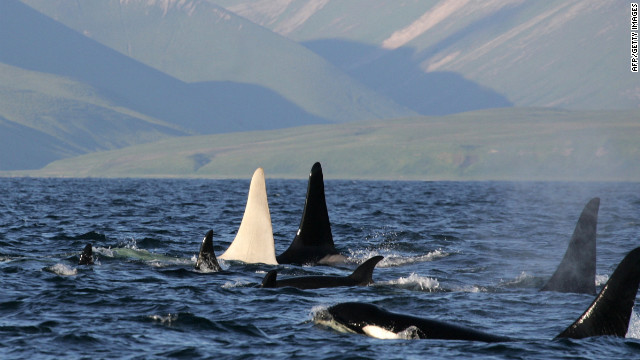 Fabulous! A real white whale! His name is Migaloo and he was first spotted in 1991. There's a video on the CNN site.
Interesting tidbits from the article:
So kind of interesting--Ahab could have been chasing his whale for decades. There is a migratory pattern that he may be able to hunt him down with. Very interesting.
'via Blog this'
It may seem straight out of Moby Dick, but a rare white whale is thrilling Australians off the eastern coast.
Interesting tidbits from the article:
Male humpbacks can travel up to 140 kilometers (87 miles) a day during their migration.
Whale watchers may be able to enjoy Migaloo for decades. Humpback whales are believed to survive as long as 90 years in the wild.
So kind of interesting--Ahab could have been chasing his whale for decades. There is a migratory pattern that he may be able to hunt him down with. Very interesting.
Wednesday, September 19, 2012
New Audio Project Offers Four Months of 'Moby-Dick' - NYTimes.com
New Audio Project Offers Four Months of 'Moby-Dick' - NYTimes.com: and a Matt Kish ink on watercolor:
 'via Blog this'
What other books do we do this for? Really?
I know there are audio versions of the Bible and religious texts. What novels though? Probably some Mark Twain, Poe...is there any other book that records each chapter by individual people, some famous, for all the world to hear?
It is especially instructive with 21st-century technology that they liken the book to basically be a 160-year-old blog:
I agree with that. And I know of the proliferation of some blogs even becoming books. But this was 1850--however, it does lend a new kind of credibility to the overall structure of Moby-Dick. I mean, like a blog, here's a book that people meander through like a maze. In that respect, yes, I can see why the book makes an impact. I just have a hard time justifying how so much of our culture knows the entire story of Moby-Dick without having read it. For instance, another really hard novel, James Joyce's Ulysses, always up there on the top books of the 20th century, is one where no one ever really alludes to it or quotes from it. (I digress but I could probably do this same blog idea about Ulysses--try to read a chapter a day and talk about it. That's another one I tried in college but couldn't force myself to do it--Pynchon's Gravity's Rainbow was another one. I've talked to people who powered through Ulysses a page a day just to say they read it. How that is actually reading a book is beyond me.)
I think I am going to try downloading and listening to these readings of each chapter. I will try again with just the audio. Should I follow along with the book? I don't know. But I want to know what these people really see in the book.
But then I see Matt Kish's brilliant illustrations and think about Hoare's statement up above. Kish meanders through Moby-Dick like a blog, creating a great artistic achievement within every single page. This is sort of like reading a favorite blog and commenting on it every day. Hoare really puts some of the fascination into perspective there.
What other books do we do this for? Really?
I know there are audio versions of the Bible and religious texts. What novels though? Probably some Mark Twain, Poe...is there any other book that records each chapter by individual people, some famous, for all the world to hear?
It is especially instructive with 21st-century technology that they liken the book to basically be a 160-year-old blog:
“The digressive nature of ‘Moby-Dick’ really suits the medium of going online,” Mr. Hoare said. “The book was never edited. It’s quite analogous to a kind of blog, really.”
I agree with that. And I know of the proliferation of some blogs even becoming books. But this was 1850--however, it does lend a new kind of credibility to the overall structure of Moby-Dick. I mean, like a blog, here's a book that people meander through like a maze. In that respect, yes, I can see why the book makes an impact. I just have a hard time justifying how so much of our culture knows the entire story of Moby-Dick without having read it. For instance, another really hard novel, James Joyce's Ulysses, always up there on the top books of the 20th century, is one where no one ever really alludes to it or quotes from it. (I digress but I could probably do this same blog idea about Ulysses--try to read a chapter a day and talk about it. That's another one I tried in college but couldn't force myself to do it--Pynchon's Gravity's Rainbow was another one. I've talked to people who powered through Ulysses a page a day just to say they read it. How that is actually reading a book is beyond me.)
I think I am going to try downloading and listening to these readings of each chapter. I will try again with just the audio. Should I follow along with the book? I don't know. But I want to know what these people really see in the book.
But then I see Matt Kish's brilliant illustrations and think about Hoare's statement up above. Kish meanders through Moby-Dick like a blog, creating a great artistic achievement within every single page. This is sort of like reading a favorite blog and commenting on it every day. Hoare really puts some of the fascination into perspective there.
Subscribe to:
Posts (Atom)