Monday, January 23, 2012

Book called "Why Read Moby-Dick"

Book Buzz: Why Read Moby-Dick?

Book Buzz: Tension City, Why Read Moby-Dick?:

I love it--it's now a book. Why Read Moby-Dick? I am going to have to find this book.

Nathaniel Philbrick is a great writer in his own right. I really enjoyed his book about the whaleshipEssex--it completely captivated me, and I usually don't like non-fiction at all.

The author of this article calls the book "a passionate and convincing text." There is no personal opinion on Moby Dick itself.

But check out this "argument." If I had a student write this, I would have the student express why the quote proves the point:

"but when he quotes Melville, the text soars and Melville’s prose becomes Philbrick’s best argument for reading the book: 'While gliding through these latter waters that one serene and moonlight night, when all the waves rolled by like scrolls of silver; and, by their soft, suffusing seethings, made what seemed a silvery silence, not a solitude. ... '"

Yes, I agree, that sentence is awesome. Should we consider Moby Dick just a long, great sounding poem then? The term novel just doesn't fit then anymore, especially if you consider structure.

I love how this piece ends:

If anyone is still awaiting the arrival of The Great American Novel(s), give it up. They have already been written. The first is “The Adventures of Huckleberry Finn” and the second is “Moby-Dick, or, The Whale.”

I just taught Huck Finn and didn't have a great experience either. But Huck Finn has a narrative structure.

Sunday, January 1, 2012

Jim Ingraham: Counting down the 10 best free-agent signings of the Dolan era - news-herald.com

Jim Ingraham: Counting down the 10 best free-agent signings of the Dolan era - news-herald.com:
"While you're waiting for the Indians to sign a big-name, big-ticket, still-in-his-prime free agent, you might want to get comfortable and curl up with a good book. I'd suggest something along the lines of "Moby Dick," "War and Peace" or the phone book from the greater Shanghai metropolitan area."

Obviously, the author is alluding to the fact that Moby Dick is a long, arduous work.

This does not do well for Moby Dick's friendly feeling. Considering my father is extremely smart but never read a book, concentrating on newspapers and sports pages in particular, this definitely hurts anyone up for a casual book. However, I think that most view it as a tough read.

Maybe that's part of its mystique; if you can read Moby Dick you must be pretty literate. (Or pretty stupid, what with all the really good books out there.)

'via Blog this'

Friday, December 30, 2011

New Jersey Herald - Some ‘Moby Dick' pieces are pursued by collectors


New Jersey Herald - Some ‘Moby Dick' pieces are pursued by collectors:
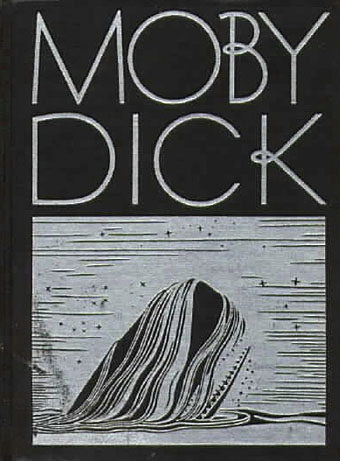
"Kent's three-volume set of "Moby Dick" was published in 1930. It was filled with Kent's haunting and dramatic black-and-white drawings and the edition sold out almost immediately. Random House issued a trade edition, also immensely popular. "Moby Dick" reportedly was a rather obscure book until the 1920s, but the new edition with Kent's illustrations helped to bring the work to the attention of the American reading public."


Utterly fascinating that there are collectors of this. What is most fascinating is the understanding that the novel was "obscure," mostly until this book with illustrations that probably made it friendlier to read.

These drawings really do help the reader to see the adventure of the book. These are reminiscent of the great drawings in early additions of The Adventures of Huckleberry Finn (See some of those here: http://etext.virginia.edu/toc/modeng/public/Twa2Huc.html).

You wonder if Kent had decided to illustrate Henry Dana's "Two Years Before the Mast" like the article says if we would be talking more about Dana than Melville today.

'via Blog this'

Tattoos of a hard-core fan


in Science Tattoo Emporium at Discover Magazine has a blog entitled The Loom, apparently from the chapter of that name in Moby Dick. In researching tattoos, he remembered the tattooed Queequeg.

"I’m a hard-coreMoby Dick fan (this blog’s name comes from there), so it was a delight to stumble across a passage on tattoos, which I had forgotten."

Just fascinating how he calls HIMSELF a hard-core fan. Of all the things in the world to be a "hard-core" fan of, I am curious as to why Moby Dick. See, this is what I need to find more about, these individuals that consider this book just that darn good.


Monday, November 7, 2011

Moby Dick graffiti

I don't know why, but MOBY DICK is in the graffiti in this issue of Hellblazer #54.

Saturday, November 5, 2011

The challenge is to read the book!

http://lifehacker.com/5856601/answer-how-much-did-you-understand-when-you-first-read-moby-dick

Daniel Russell has a column called Search ReSearch where he issues challenges to find information in our tech world. He picked Moby Dick for the latest one. Catch what he says about the book as a whole first:

If you're like me, you probably read Moby Dick at some point in your life. Maybe in high school, maybe for general reading later on in life. Regardless of when you read it, you probably have a pretty good mental image of the story, right? Captain Ahab and the search for the great white whale... maybe something about the inherent qualities of mankind, some ideas about man vs. nature, madness and a bunch of characters, the likes of which would never enter a Starbucks, but would prefer their grog on the open sea.

Challenge: How Much Did You Understand When You First Read Moby Dick?

Whenever it was that you read Moby Dick, how much of it did you understand? Let's test your level of understanding: You know what a right-whale is, you probably remember the difference between a top-sail and a stun-sail, and you remember the characters of Starbuck, Queequeg and Ishmael, right?


He then goes on to issue a challenge to find some obscure traits about the Pequod. The question and answer is here at

http://lifehacker.com/5856601/answer-how-much-did-you-understand-when-you-first-read-moby-dick

Cool. And he had to go to the real text to get an answer and then powered through it with a good old CTRL-F find method. Didn't re-read it or anything, though.

Overall, I wonder how many high schools still teach Moby Dick. I wouldn't dare for fear of mutiny. It's a very cursory factual understanding that Russell shows above and I would be interested if all that didn't come out of a quick search rather than his memory.

Friday, November 4, 2011

Celebrating 160 years of Moby Dick in a weekend

http://www.southcoasttoday.com/apps/pbcs.dll/article?AID=/20111103/ENTERTAIN/111030302

Published on November 3, 2011, "It's a very 'Moby' weekend" is an article by Lauren Daley for South Coast Today. She hits it right on the head several times about this strange novel pervading our culture.

"This whole thing started by asking the question: 'How do people come to know "Moby-Dick"?' Because you know 90 percent of the public hasn't read the book," said Katherine Knowles, executive director of the Zeiterion.

Yet amazingly, we still keep saying--

"Moby-Dick" (1851) is largely considered one of the greatest works in all of American literature.

Everybody knows that the whale is everywhere, but no one knows why--

"Moby-Dick," part of the American literary canon, has also become a part of 20th- and 21st-century pop culture, showing up in everything from a Led Zeppelin song to "The Simpsons" to "Star Trek."

"The fact is that 'Moby-Dick' has become iconic," Knowles said. The cartoon character "Mr. Magoo played Ahab. Tom and Jerry played out the story; 'The Simpsons' have done the story. 'Moby-Dick' is now pop culture.


So they have all kinds of activities going on to celebrate. Do they do this for The Scarlet Letter? Or Huck Finn?